

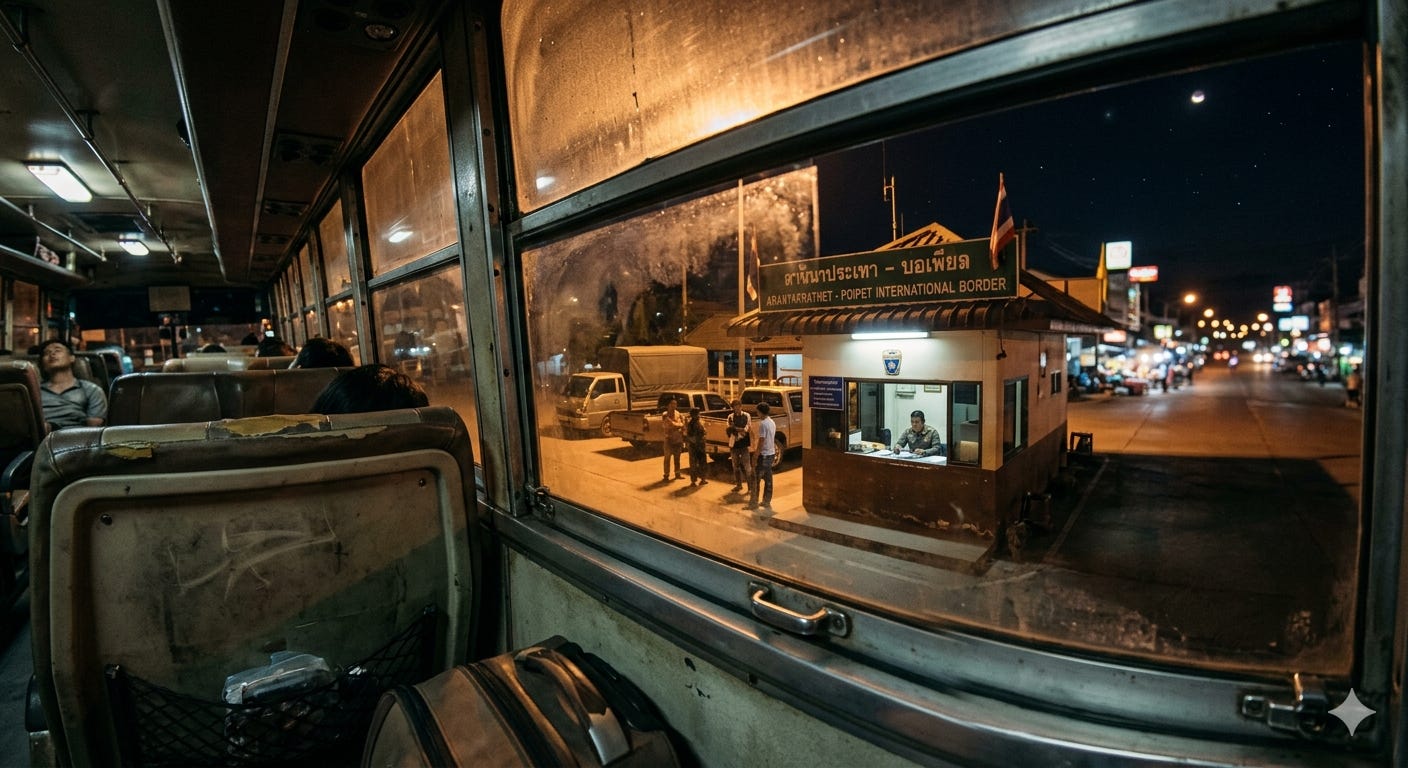
I spent twenty hours on a bus yesterday. For anyone living the visa run life, that sounds like a journey through the ninth circle of hell. In reality, it’s a logistical miracle.
Usually, this trip takes three full days of navigating mismatched bus schedules, border-town guesthouses, and the general anxiety of being stranded. But I found a company with a real advantage. They don’t use scheduled services; they have their own fleet, and they offer one sacred, non-negotiable promise: The bus does not move until every single passenger has their passport back.
It is a beautiful, fragile social contract. We all get home in one day because we agree to wait for the slowest link in the chain.
A quick disclaimer on complaining
Now, don’t get me wrong. I am not anti-complaining. I think complaining is a vital human tool when it’s directed at a solvable problem. For instance, we cross the border at 8:00 AM and are dropped at a cluster of cafes to wait for the paperwork. There are two cafes, both of them open, and yet neither of them serves breakfast.
It is 8:00 AM. We have been on a bus since the middle of the night. There isn’t so much as a bowl of sticky rice to be found. That is a gross oversight and a missed business opportunity, and I will complain about that lack of caffeine and carbs until the sun goes down. That is a substance complaint. It’s about a failure of service.
But the other kind of complaining I heard yesterday? That’s something else entirely.
The irony of the A/C grumble
Inevitably, there is a snag. On a bus of thirty people, someone is going to have a paperwork glitch. A border official takes a long lunch, or a computer system hangs. We sat in the air-conditioned bus for two extra hours yesterday waiting for two people we didn’t know.
And then, it started. The heavy sighing. The checking of watches. The hissed whispers about how inconsiderate the missing passengers were.
It was bizarre to witness. These people didn’t book a private limo; they booked a seat on a collective safety net. The anger was framed as if the company had promised: We will wait for you, specifically, but we’ll leave those other people to rot in no-man’s-land the second your stamp is dry.
They wanted the benefit of the guarantee without the burden of the guarantee being applied to anyone else.
The I’ve got mine glitch
This is a micro-version of a massive human glitch. We love the protection of a system until the exact moment we no longer personally need it.
If the company actually started leaving people behind to save an hour, the entire business model would collapse. The guarantee would be gone. The very thing these grumblers paid for—the security of knowing they won’t be abandoned—is the exact thing they were complaining about in real-time.
But once their passport was in their pocket and their seat was reclined, the collective ceased to exist for them. The people still in the office weren’t fellow travelers anymore; they were obstacles.
Beyond the border
This mindset is the rot at the foundation of how we talk about almost everything—from healthcare to infrastructure to the way we vote.
We often think of the social contract like slot machine instead of an insurance policy. We want the well-paved road, but we resent the construction that slows us down. We want the safety of a healthy, educated society, but we scoff at the wait time or the cost required to bring the last person across the line.
The reality is that the deal only works if it’s absolute. A safety net with holes in it isn’t a safety net; it’s just a decorative lace.
When we look at the decisions we make—personally or politically—we have to stop thinking about them solely through the lens of when do I get mine? The strength of a society isn’t measured by how fast the first person gets through the gate. It’s measured by our willingness to keep the engine running until the last person is on the bus.
Because the truth of the visa run is the truth of life: Eventually, you’re going to be the one with the paperwork glitch. And when that happens, you’d better hope you’re on a bus full of people who understand that we’re all going home together, or nobody is.
Follow more reflections on the mundane and the meaningful at The Low Stakes.